Stepping into the Metaverse: How AR/VR Will Revolutionize Remote Work and Virtual Collaboration
Remote work has reshaped our professional lives, proving that productivity isn't confined to a physical office. While video conferencing has been the backbone of this shift, the future of virtual collaboration is rapidly moving beyond 2D screens. Augmented Reality (AR) and Virtual Reality (VR) are poised to unlock unprecedented levels of immersion, presence, and efficiency, transforming how we connect and create from anywhere in the world.
This isn't just about gaming anymore; AR and VR are becoming sophisticated tools that will fundamentally change the remote work experience. Here’s how:
1. Creating a Sense of "Presence": Beyond the Brady Bunch Grid
The biggest limitation of current video calls is the lack of true presence. AR and VR bridge this gap by creating shared virtual spaces that mimic the feeling of being in the same room.
-
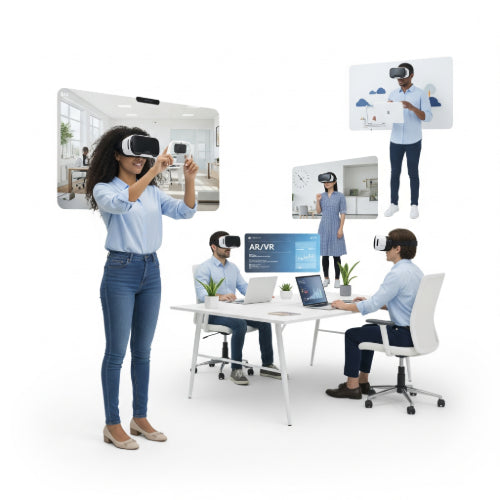
Virtual Meeting Rooms: Imagine donning a VR headset and stepping into a virtual conference room where you and your colleagues, represented by realistic avatars, can sit around a table, whiteboard ideas, and interact with 3D models. Spatial audio makes it feel like voices are coming from where people are positioned in the virtual space, allowing for more natural conversations and less "talking over" each other.
-
Immersive Workspaces: For deep work and focused collaboration, AR/VR can create personalized virtual offices. You could have multiple virtual monitors, a quiet environment, and even shared digital whiteboards that persist across sessions, mimicking the best aspects of a physical office without the commute.
-
Non-Verbal Cues: Avatars are becoming increasingly expressive, capturing subtle head nods, hand gestures, and even eye movements, allowing for richer non-verbal communication that's often lost in traditional video calls.
2. Revolutionizing Collaboration on Complex Tasks:
AR and VR excel at visualizing and interacting with 3D content, making them invaluable for specific industries and tasks.
-
3D Design and Prototyping: Architects, engineers, and product designers can collaboratively view, manipulate, and annotate 3D models in real-time, walking through virtual buildings or examining prototypes as if they were physically present. This speeds up design cycles and reduces the need for expensive physical mock-ups.
-
Remote Assistance and Training with AR Overlays: For field service, maintenance, or complex machinery operation, AR allows experts to overlay digital instructions, diagrams, or even live video feeds onto the real-world view of a remote worker. This enables hands-on guidance and troubleshooting from anywhere, minimizing downtime and travel costs.
-
Immersive Training and Simulations: From medical procedures to highly dangerous industrial operations, VR offers safe and realistic environments for training and skill development. Employees can practice complex tasks repeatedly, making mistakes without real-world consequences, leading to faster learning and higher retention rates.
3. Enhancing Productivity with Intelligent Features:
The integration of AI with AR/VR will further supercharge productivity in remote work.
-
AI-Powered Assistants: Virtual assistants within AR/VR environments could manage schedules, take meeting minutes, translate languages in real-time, and even suggest relevant information or files based on the ongoing conversation.
-
Smart Whiteboarding and Brainstorming: Digital whiteboards can automatically organize ideas, convert scribbles into text, and even generate visual summaries of brainstorming sessions.
-
Contextual Information Overlays: AR glasses could display relevant data or notifications directly in your field of vision without interrupting your workflow, keeping you informed and efficient.
4. Fostering Culture and Connection:
Beyond tasks, AR/VR can help rebuild the informal connections and team cohesion often missed in remote settings.
-
Virtual Social Spaces: Companies can create virtual "water coolers," lounges, or even game rooms where colleagues can casually interact, fostering spontaneous conversations and strengthening team bonds that are crucial for a healthy company culture.
-
Virtual Team Building Activities: Imagine team-building exercises, escape rooms, or even virtual celebrations taking place in shared immersive environments, creating memorable experiences despite geographical distances.
Challenges and the Road Ahead:
While the potential is immense, several factors need to mature for widespread adoption:
-
Hardware Accessibility and Cost: While improving, AR/VR headsets still have a price point and comfort level that can be a barrier for mass enterprise deployment. Lighter, more affordable, and more comfortable devices are crucial.
-
Bandwidth and Latency: Highly immersive experiences demand robust internet connectivity and minimal latency to feel truly seamless.
-
Interoperability: Ensuring different AR/VR platforms and devices can seamlessly communicate and share content will be vital for a truly collaborative ecosystem.
-
Privacy and Security: As these technologies collect more data about user interactions and environments, robust privacy protocols and security measures will be paramount.
The future of remote work is undeniably immersive. AR and VR are not just niche tools but powerful platforms that will redefine how we collaborate, learn, and connect across distances. As the technology evolves, expect to see offices dissolve into a network of highly engaged, digitally present teams, pushing the boundaries of what's possible in the world of work.