Server Rack Cabinets vs Wall-Mount Racks: Which Is Best for You?
In today's data-driven world, whether you're running a small business, a growing enterprise, or even a sophisticated home lab, organizing your IT equipment is crucial. Not only does it protect your valuable servers, switches, and other devices, but it also improves airflow, simplifies cabling, and streamlines maintenance. When it comes to choosing the right housing for your hardware, two primary options often come to mind: server rack cabinets and wall-mount racks.
While both serve the purpose of organizing equipment, they cater to different needs and environments. Understanding their distinctions is key to making the best decision for your setup.
Understanding the Basics
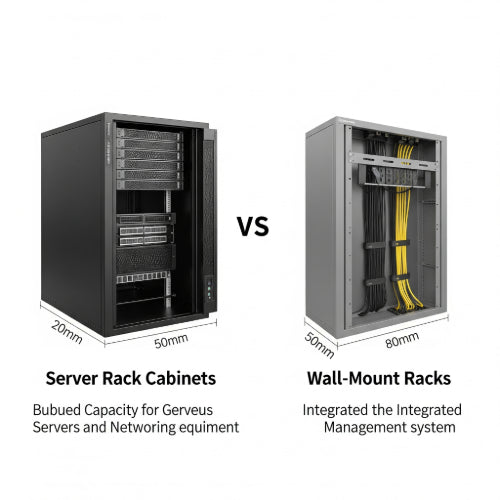
Server Rack Cabinets (Floor-Standing Racks): These are essentially freestanding enclosures, typically ranging from 22U (rack units) to 48U or more in height. They are designed to sit on the floor and provide a secure, enclosed environment for a significant amount of IT equipment. They often come with front and rear doors, side panels, and integrated cable management features.
Wall-Mount Racks: As the name suggests, these racks are designed to be mounted directly onto a wall. They are typically smaller in stature, ranging from 4U to 22U. Wall-mount racks can be open-frame (just rails) or enclosed cabinets with a front door and sometimes side panels.
Key Differences to Consider
Let's delve into the factors that differentiate these two rack types:
1. Capacity and Scalability:
- Server Rack Cabinets: Offer much higher capacity. Their floor-standing design allows for greater height (more U space) and deeper dimensions, accommodating a larger number of servers, UPS units, and other deep-form factor equipment. They are built for scalability as your IT infrastructure grows.
- Wall-Mount Racks: Have limited capacity due to their smaller size. They are ideal for housing a few switches, patch panels, network appliances, or shallow-depth servers. Scaling up significantly often means needing to add another wall-mount rack or eventually transitioning to a floor-standing cabinet.
2. Security and Protection:
- Server Rack Cabinets: Provide superior security. With lockable front and rear doors, and often lockable side panels, they offer a high level of physical security, preventing unauthorized access to your valuable equipment. They also protect against dust, accidental bumps, and environmental factors.
- Wall-Mount Racks: Enclosed wall-mount racks offer some security with a lockable front door. However, open-frame wall mounts offer no physical security. They are less protected from dust and potential physical damage compared to full cabinets.
3. Space Requirements and Footprint:
- Server Rack Cabinets: Require dedicated floor space. While they are designed to be efficient for their capacity, you need to consider the physical footprint of the cabinet itself, plus clearance for opening doors and working behind it.
- Wall-Mount Racks: Excellent for saving floor space. By utilizing vertical wall space, they are perfect for locations where floor space is at a premium, such as small offices, classrooms, retail environments, or utility closets.
4. Cable Management:
- Server Rack Cabinets: Typically offer comprehensive internal cable management options, including vertical and horizontal cable managers, allowing for neat and organized cabling for a large number of devices. This is crucial for airflow and troubleshooting.
- Wall-Mount Racks: Cable management options are more limited due to their compact size. While some enclosed versions offer basic routing, managing many cables in a wall-mount can be challenging.
5. Cooling and Airflow:
- Server Rack Cabinets: Often designed with advanced cooling considerations. They can have perforated doors for passive airflow, or be configured with active cooling solutions like fan trays or even integrated air conditioning units for dense deployments.
- Wall-Mount Racks: Airflow is generally less controlled. Open-frame wall mounts rely entirely on the room's ambient air. Enclosed wall mounts may have limited ventilation or require additional fan units, which can be less efficient than a full cabinet's cooling design.
6. Weight Capacity:
- Server Rack Cabinets: Designed to hold substantial weight, supporting multiple heavy servers, UPS systems, and other robust equipment.
- Wall-Mount Racks: Have a much lower weight capacity, limited by their construction and the wall's ability to bear the load. They are suitable for lighter network gear.
7. Portability and Installation:
- Server Rack Cabinets: Once assembled and loaded, they are generally stationary. Moving them requires significant effort, often involving dismantling and reassembly. Professional installation might be recommended for larger units.
- Wall-Mount Racks: Lighter and easier to install, though still requiring proper mounting to wall studs or anchors. Their smaller size makes them easier to relocate if needed.
8. Cost:
- Server Rack Cabinets: Generally more expensive due to their larger size, robust construction, and advanced features.
- Wall-Mount Racks: More budget-friendly, especially the open-frame versions.
Which is Best for You?
To make the right choice, consider the following:
-
For Growing Businesses & Data Centers: If you have a significant amount of IT equipment, expect future expansion, require high security, advanced cooling, and excellent cable management, a server rack cabinet is the clear winner. This applies to dedicated server rooms, larger offices, or co-location facilities.
-
For Small Offices, Classrooms, or Branch Locations: If you have limited floor space, a smaller amount of network gear (switches, routers, patch panels, NVRs), and don't require heavy-duty security or advanced cooling, a wall-mount rack is likely your best option. They are perfect for edge deployments or telecommunications closets.
-
For Home Labs: Depending on the scale of your home lab, either could work. A small wall-mount rack is great for a few network devices. If you're running multiple servers and complex setups, a smaller server rack cabinet (e.g., 22U) might be more appropriate.
Conclusion
Both server rack cabinets and wall-mount racks are invaluable tools for organizing and protecting IT equipment. The "best" choice isn't universal; it depends entirely on your specific needs regarding capacity, security, available space, cooling requirements, and budget. By carefully evaluating these factors, you can select the perfect solution to ensure your office's IT infrastructure is robust, secure, and ready for whatever comes next.