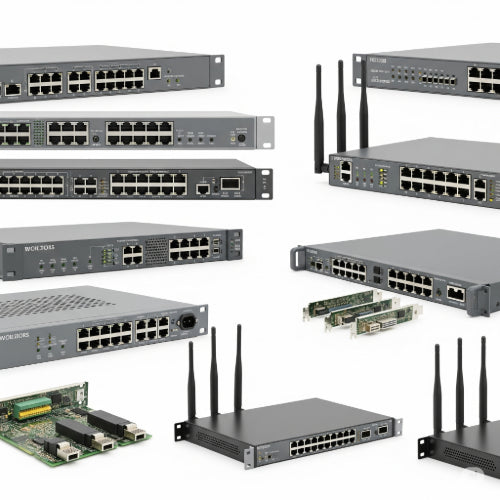
The 5G Revolution: Reshaping Business Networks and the Role of Switches
5G, the fifth generation of cellular technology, is far more than just faster internet for our smartphones. It's a foundational shift that's fundamentally reshaping how businesses operate, communicate, and innovate. With its unprecedented speeds, ultra-low latency, and massive capacity, 5G is poised to revolutionize enterprise networks, and in doing so, redefine the critical role of network switches.
For decades, business networks have relied on a combination of wired infrastructure and Wi-Fi to connect devices and facilitate data flow. While robust, these traditional setups often faced limitations in speed, responsiveness, and the sheer volume of connected devices they could reliably support. Enter 5G, a wireless game-changer that introduces a new paradigm for connectivity.
The Pillars of 5G: What's Driving the Impact
To understand 5G's influence on business networks, it's essential to grasp its core characteristics:
-
Enhanced Mobile Broadband (eMBB): This is the most visible aspect, delivering significantly higher data speeds (up to 100 times faster than 4G) and greater bandwidth. For businesses, this means lightning-fast file transfers, seamless high-definition video conferencing, and the ability to leverage cloud-based applications with unprecedented efficiency.
-
Ultra-Reliable Low Latency Communications (URLLC): This is arguably the most transformative aspect for many industries. With latency as low as 1 millisecond, 5G enables near-instantaneous communication between devices and the network. This is critical for applications like autonomous systems, real-time control of industrial machinery, remote surgery, and augmented/virtual reality (AR/VR) applications that demand split-second responses.
-
Massive Machine Type Communications (mMTC): 5G can support an enormous density of connected devices – up to a million per square kilometer. This capability is the backbone for the Internet of Things (IoT) at scale, allowing businesses to deploy vast networks of sensors, smart devices, and automated systems for everything from predictive maintenance in manufacturing to real-time inventory management in retail.
How 5G is Impacting Business Networks
These fundamental capabilities translate into several significant impacts on business networking:
-
Wireless as a Primary Backbone: 5G's reliability and speed mean it can serve as a primary or complementary connection for business locations, offering a robust alternative or backup to traditional wired broadband, especially for remote offices or pop-up sites. Fixed Wireless Access (FWA) enabled by 5G is a compelling alternative for broadband delivery.
-
Edge Computing Enablement: The low latency of 5G is a perfect match for edge computing. By processing data closer to its source (at the "edge" of the network), businesses can achieve faster insights and make real-time decisions, crucial for applications in smart cities, manufacturing automation, and healthcare.
-
Rise of Private 5G Networks: For enterprises with specific security, performance, or coverage requirements, private 5G networks offer dedicated, isolated cellular networks. These provide a highly secure and customized environment for critical operations, maintaining data within the business's control.
-
Network Slicing for Customized Performance: One of 5G's most innovative features is network slicing. This allows mobile operators to create multiple virtual, logical networks on a single physical 5G infrastructure. Each "slice" can be customized with specific performance characteristics (e.g., bandwidth, latency, security) tailored to different business applications. A manufacturing plant, for instance, could have a dedicated ultra-low latency slice for its robots, while its administrative office uses a standard broadband slice – all on the same physical network.
-
Explosion of IoT Devices: The massive capacity of 5G makes large-scale IoT deployments feasible and efficient. Businesses can connect thousands of sensors, cameras, and smart devices without fear of network congestion, unlocking new data streams for operational optimization and innovative services.
-
Enhanced Remote Work and Collaboration: With highly reliable and fast wireless connectivity, remote work becomes even more seamless. Video conferencing is clearer, cloud applications are more responsive, and distributed teams can collaborate with greater efficiency.
The Evolving Role of Network Switches
While 5G brings wireless prowess, it doesn't diminish the importance of network switches; rather, it elevates and reshapes their role:
-
Connecting the 5G Edge: As 5G enables more edge computing and localized private networks, high-performance switches are essential for aggregating and distributing data from a multitude of 5G-connected devices at the local level. They act as the crucial bridge between the wireless 5G access and the wired enterprise network.
-
Handling Increased Data Volume: The sheer volume of data generated by 5G applications and IoT devices will demand switches with higher throughput, increased port density, and advanced processing capabilities. Core and distribution switches, in particular, will need to handle unprecedented amounts of traffic.
-
Supporting Network Slicing and Virtualization: Switches with advanced capabilities (e.g., Layer 3 switches, SDN-enabled switches) are vital for routing traffic efficiently across different 5G network slices. They need to understand and prioritize traffic based on the specific requirements of each slice, ensuring that mission-critical applications receive the necessary performance.
-
Powering Edge Devices (PoE): Many 5G-enabled IoT devices and edge sensors require power. Power over Ethernet (PoE) switches will become even more prevalent, simplifying deployment and reducing cabling complexity for these devices.
-
Enhanced Security at the Edge: With a larger attack surface due to more connected devices, switches play a critical role in enforcing security policies, segmenting networks, and isolating potential threats at the edge, acting as the first line of defense for 5G-enabled networks.
-
Integration with SD-WAN: 5G can be seamlessly integrated into Software-Defined Wide Area Networks (SD-WAN) strategies, with switches managing local traffic and ensuring optimal routing over 5G links, especially for branch offices and remote locations.
The Road Ahead
The impact of 5G on business networks is profound and ongoing. Businesses that strategically embrace 5G capabilities, alongside a robust and intelligent switching infrastructure, will be well-positioned to unlock new levels of efficiency, innovation, and competitive advantage. The future of enterprise connectivity is undoubtedly a hybrid one, where the power of 5G wireless intertwines seamlessly with the intelligence and reliability of advanced network switches, creating agile, high-performing, and secure networks for the digital age.