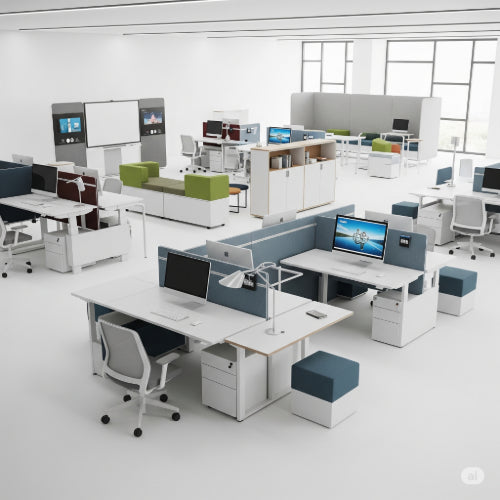
The Self-Adjusting Office: How Autonomous Systems Will Shape the Furniture Industry
The office environment is undergoing a profound transformation. Beyond flexible layouts and biophilic design, a silent revolution is brewing, driven by autonomous systems. This isn't just about robots assembling chairs in a factory; it's about intelligent furniture that understands, adapts, and responds to human needs, fundamentally reshaping how office furniture is designed, manufactured, and utilized.
Autonomous systems, powered by AI, IoT, and robotics, are poised to elevate office furniture from static objects to dynamic, responsive elements of a truly smart workplace. Here's how:
1. On-Demand Customization and Generative Design:
Forget standard product catalogs. The future office will be filled with furniture precisely tailored to individual and team requirements, with autonomous systems driving the design process.
-
AI-Powered Generative Design: Designers will leverage AI algorithms that can generate countless furniture designs based on specific ergonomic needs, aesthetic preferences, spatial constraints, and material properties. This enables mass customization on an unprecedented scale, moving away from limited options to truly bespoke solutions.
-
Rapid Prototyping with Robotics: Once a design is finalized, robotic manufacturing processes, including advanced 3D printing and CNC machining, will allow for rapid, on-demand prototyping and production. This reduces lead times and allows for quicker iteration and refinement of personalized furniture pieces.
-
"Furniture on Demand": Imagine designing a unique desk online, and an autonomous factory produces and delivers it within days, precisely to your specifications. This level of responsiveness will be a game-changer for businesses needing to adapt quickly to changing team sizes or work styles.
2. Intelligent, Adaptive Furniture in the Workspace:
The real impact of autonomous systems will be felt daily within the office itself, with furniture that learns and reacts.
-
Self-Adjusting Ergonomics: Chairs will automatically adjust lumbar support, seat depth, and armrest height based on an individual's posture and movements, detected by embedded sensors. Desks will autonomously shift between sitting and standing heights throughout the day, prompting users to move for optimal health and focus.
-
Context-Aware Environments: Furniture integrated with IoT sensors will monitor environmental factors like temperature, lighting, and noise levels in a localized area. Autonomous systems can then adjust integrated lighting, activate sound-masking features, or even direct localized airflow from smart vents to create an optimal micro-environment for each user, based on their personal preferences and task requirements.
-
Dynamic Space Utilization: Autonomous, movable furniture modules will reconfigure office layouts based on real-time occupancy data, meeting schedules, or even the type of work being performed. Need a collaborative zone for an impromptu meeting? Autonomous tables and chairs could automatically re-arrange themselves. This maximizes space efficiency and adapts the office to evolving needs without manual intervention.
3. Predictive Maintenance and Lifecycle Management:
Autonomous systems will transform the maintenance and longevity of office furniture.
-
Proactive Health Monitoring: Sensors embedded in furniture will continuously monitor wear and tear, material integrity, and operational performance. AI algorithms will analyze this data to predict potential malfunctions or maintenance needs before they occur.
-
Automated Repairs and Replacements: For minor issues, autonomous robots could perform simple repairs. When replacement is needed, the system could automatically flag the component, order a new one, and even schedule its installation, minimizing downtime and extending furniture lifespan.
-
Circular Economy Integration: Autonomous systems can facilitate the recycling and repurposing of furniture components at the end of their useful life, contributing to a more sustainable, circular economy within the office furniture industry.
4. Streamlined Logistics and Installation:
The movement and setup of furniture, often a logistical headache, will also be impacted.
-
Autonomous Delivery and Assembly: Drones and autonomous guided vehicles (AGVs) could transport furniture components within warehouses and even to office locations. Robotic arms could assist or even fully automate the assembly process on-site, particularly for modular systems.
-
Optimized Space Planning: AI-driven tools, fed with building blueprints and user data, can autonomously generate the most efficient and ergonomic furniture layouts, even accounting for foot traffic patterns and collaboration needs, simplifying the installation process.
Challenges and the Human Element:
While the possibilities are exciting, challenges exist:
-
Data Privacy: Autonomous furniture will collect vast amounts of personal data. Robust privacy protocols and transparent data usage policies will be critical for user acceptance and trust.
-
Interoperability: Ensuring seamless communication between diverse furniture pieces, building management systems, and user interfaces will be complex.
-
Initial Investment: The advanced technology involved will likely mean higher upfront costs, though these could be offset by long-term energy savings, increased productivity, and extended product life.
-
Human-Centric Design: Crucially, autonomous systems must augment, not replace, human comfort and intuition. The technology should enhance, rather than dictate, the user experience.
The office furniture industry is moving beyond static objects to intelligent, responsive systems. Autonomous furniture will become an active participant in creating dynamic, personalized, and hyper-efficient workspaces, truly shaping the office of the future. The era of the self-adjusting, self-optimizing office is no longer a distant dream, but an impending reality.