UPS vs. PDU: What’s the Difference and Which One Do You Need?
In any modern office or data center, reliable power is the backbone of operations. Without it, your critical equipment grinds to a halt, leading to lost data, downtime, and significant financial impact. When planning your power infrastructure, you'll inevitably encounter two key devices: Uninterruptible Power Supplies (UPS) and Power Distribution Units (PDUs). While both deal with electricity, they serve distinct and equally vital roles.
Let's clarify the difference between a UPS and a PDU and help you determine which one (or both!) your business needs.
What is a UPS (Uninterruptible Power Supply)?
Think of a UPS as your short-term power insurance policy. Its primary function is to provide continuous power to connected equipment during power outages or fluctuations.
How it Works:
A UPS contains a battery (or battery bank) and inverter circuitry. When the incoming utility power is stable, the UPS typically charges its battery and can also filter incoming power. The moment utility power drops, surges, or cuts out entirely, the UPS instantly switches to battery power, providing a seamless transition. This gives you precious minutes (or sometimes hours, depending on the UPS size and load) to:
- Gracefully shut down sensitive equipment, preventing data corruption and hardware damage.
- Ride through brief power flickers or sags.
- Keep critical systems running until utility power returns or a generator kicks in.
Key Features of a UPS:
- Battery Backup: The core function, providing temporary power during outages.
- Surge Protection: Protects against damaging voltage spikes.
- Voltage Regulation: Corrects sags (brownouts) and swells (overvoltage) in incoming power.
- Power Conditioning: Filters out electrical "noise" that can interfere with sensitive electronics.
- Software Integration: Many UPS units come with software that allows for monitoring, automated shutdowns, and event logging.
Who Needs a UPS?
Any business or individual with critical electronic equipment that cannot afford sudden power loss needs a UPS. This includes:
- Servers: Essential for preventing data corruption and ensuring continuous service.
- Network Equipment: Routers, switches, firewalls – keeping these online maintains connectivity.
- Workstations/Desktop PCs: Especially for employees working on unsaved documents or critical applications.
- Point-of-Sale (POS) Systems: To prevent transactions from being lost during power interruptions.
- Medical Equipment: Where uninterrupted power is literally a matter of life and death.
What is a PDU (Power Distribution Unit)?
A PDU is essentially a sophisticated power strip designed for rack-mounted equipment in data centers, server rooms, or professional AV setups. Its main purpose is to distribute power reliably and efficiently to multiple devices from a single power source.
How it Works:
A PDU takes one or more incoming power feeds and provides multiple outlets for equipment. While basic PDUs simply distribute power, more advanced "intelligent" PDUs offer a range of features for monitoring and management.
Key Features of a PDU:
- Multiple Outlets: Provides numerous outlets (e.g., C13, C19, NEMA) for connecting rack-mounted equipment.
- Rack-Mountable: Designed to fit neatly into server racks, often vertically or horizontally.
- Circuit Breakers: Protects against overloads.
-
Monitoring (for Intelligent PDUs):
- Basic Monitoring: Current, voltage, power consumption at the unit level.
- Outlet-Level Monitoring: Tracks power usage of individual outlets.
- Environmental Monitoring: Connects to sensors for temperature and humidity.
-
Remote Management (for Switched PDUs):
- Remotely turn individual outlets on/off (e.g., to hard-reboot a server).
- Set power-on/off sequences for devices.
- Receive alerts for power events.
Who Needs a PDU?
Anyone with a rack full of equipment, particularly in a data center or server room environment, benefits immensely from a PDU. This includes:
- Data Centers: For efficient power distribution and granular monitoring of server racks.
- Server Rooms: To power multiple servers, network devices, and storage arrays.
- Telecommunications Facilities: For powering and managing networking gear.
- Audiovisual (AV) Setups: In control rooms or professional installations.
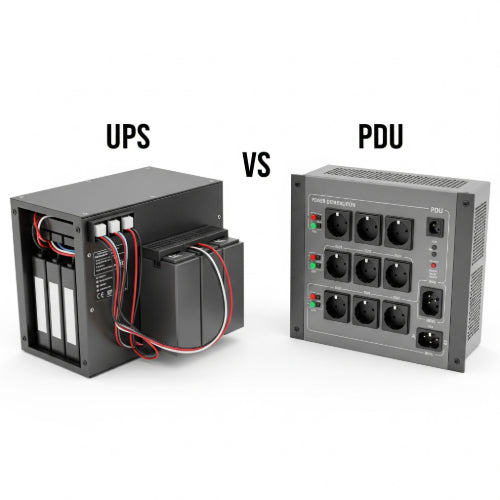
UPS vs. PDU: The Synergy
It's not a matter of choosing one over the other; in most professional environments, you need both.
- The UPS protects your equipment from power anomalies and provides crucial uptime during outages. It's the primary line of defense for power quality and continuity.
- The PDU efficiently distributes that clean, conditioned power from the UPS to all your devices within the rack. Intelligent PDUs then add layers of monitoring and remote management capabilities, maximizing efficiency and control.
Think of it this way: The UPS is the robust power generator/conditioner, and the PDU is the advanced power strip that smartly distributes that power to all your individual devices, often with monitoring and remote control.
Conclusion
Understanding the distinct roles of UPS and PDU is vital for building a resilient and efficient power infrastructure. A UPS ensures your critical systems stay online during power disruptions, while a PDU intelligently distributes and manages power to your rack-mounted equipment. Together, they form a robust solution that protects your valuable technology investments and keeps your business running smoothly, regardless of external power fluctuations.